GLP-1 medications like Ozempic and Wegovy work — but they can strip muscle alongside fat.
GLP-1 is helping you lose fat. But muscle too.
GLP-1 medications work. The weight loss is real. But research shows that
25–40% of what you lose on semaglutide or tirzepatide isn't fat — it's muscle. For a 40-lb loss, that could mean 15 lbs of lean mass gone.
The goal isn't to slow your weight loss. It's to make sure what you're losing is almost entirely fat — and that the body you end up with actually performs the way you want it to.


What's Actually
Happening on GLP-1
GLP-1 suppresses appetite aggressively. Under a sustained caloric deficit, your body cannibalises muscle alongside fat. A 2023 analysis found semaglutide users lost approximately 39% of their total weight as lean mass without deliberate intervention.
Bikou A, Dermiki-Gkana F, Penteris M, Constantinides TK, Kontogiorgis C. A systematic review of the effect of semaglutide on lean mass: insights from clinical trials. Expert Opin Pharmacother. 2024;25(5):611–619.
Why that matters beyond aesthetics


Two Things Your Prescription Can't Do
Resistance training is non-negotiable — it's the most effective single intervention for directing GLP-1 weight loss toward fat rather than muscle. But even committed lifters hitting their protein targets often find muscle preservation harder than expected on GLP-1. The reason is cellular, not nutritional.
American Diabetes Association, Standards of Care in Diabetes — 2024, Diabetes Care, Vol 47, Suppl 1.


A sustained caloric deficit suppresses two things: mitochondrial energy output (so cells can't execute repair signals) and the gene-level pathways that govern muscle maintenance (so the signals don't get through even if the energy were there). Training and protein address neither of these directly. That's the gap the Pürblack stack closes.

Restore the Cellular Environment
Before a muscle-preservation signal can do its job, your cells need the energy to act on it. Caloric restriction reduces mitochondrial efficiency — cells run on less power, repair is slower, and the training stimulus lands with less effect. White Rabbit addresses this first.
Shilajit's primary bioactive fractions — fulvic acid and dibenzo-alpha-pyrones (DBPs) — restore electron transport chain function at Complex I and Complex II, the primary sites of cellular ATP production. Bhattacharyya et al. (Mol Cell Biochem, 2009) demonstrated this directly, showing fulvic acid restoring mitochondrial respiratory activity in depleted conditions. More energy at the cell level means faster recovery, stronger response to training, and a better environment for lean mass preservation.
Fulvic acid also reduces TNF-alpha and oxidative stress (Velmurugan et al., 2012) — the same inflammatory mediators that suppress muscle regeneration under chronic caloric restriction — and acts as a biological carrier, improving absorption of every other compound in your protocol (Pant et al., Asian J Pharm Clin Res, 2012).
Bhattacharyya S et al., Mol Cell Biochem, 2009; Velmurugan C et al., 2012; Pant K et al., Asian J Pharm Clin Res, 2012; AgarwalSP et al., Phytother Res, 2007.
The Gene-Level Signal
Your body has a built-in muscle maintenance programme driven by two gene pathways: ACTN3, which governs structural metabolism in fast-twitch muscle fibers, and Myf5, the master switch that recruits new muscle cells. When both are active, your body builds and holds lean tissue. Sustained caloric restriction and chronic inflammation suppress both — regardless of how much protein you eat or how hard you train.
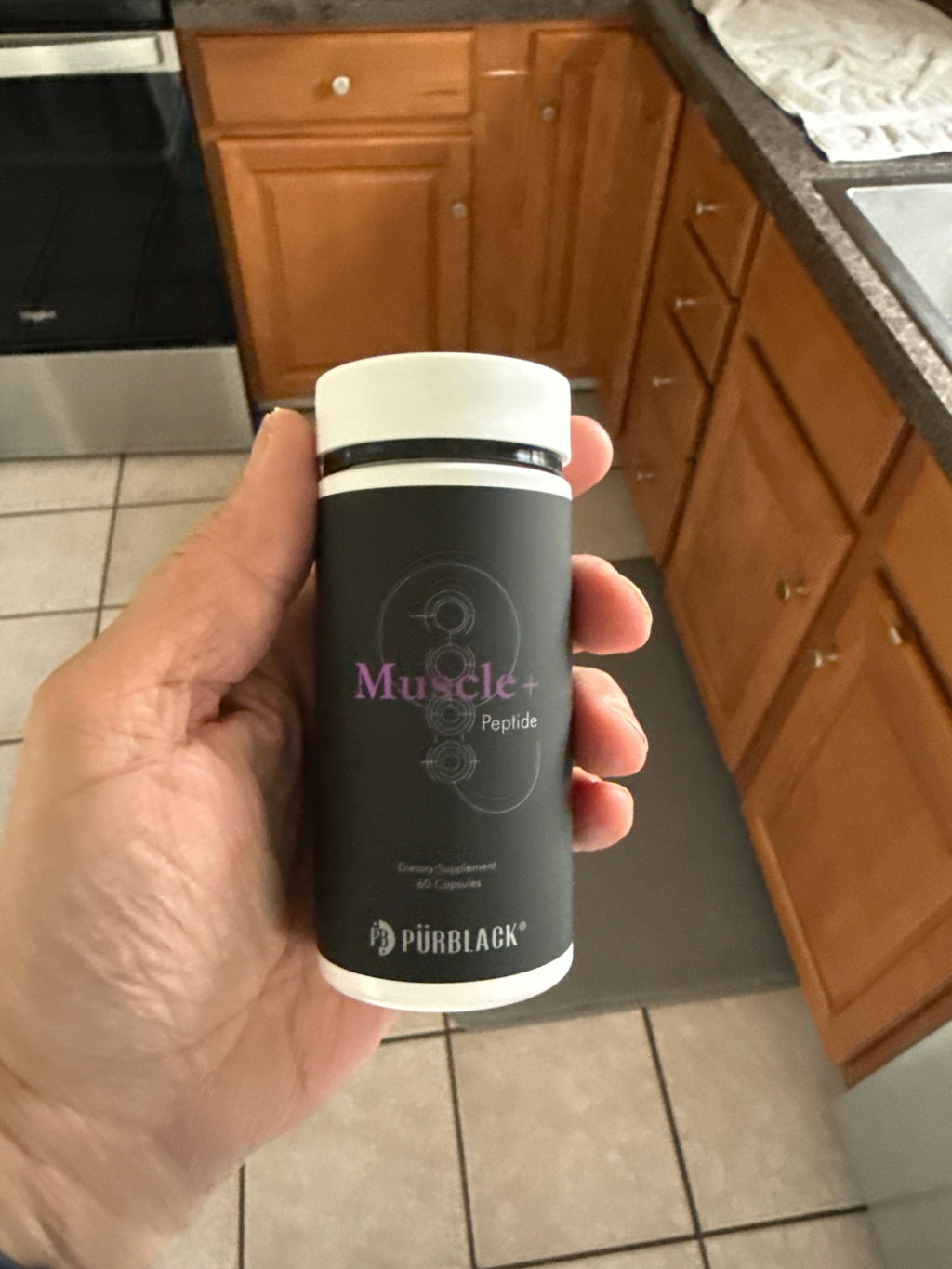
IPH-AGAA, the active ingredient in Muscle+, keeps those switches on. In human cell culture it increased ACTN3 expression 4.5 times and Myf5 2.9 times versus control, and significantly reduced premature muscle cell death — directly relevant for anyone in a prolonged caloric deficit. In an animal injury model it reduced TNF-alpha by 61% and IL-1 beta by 32%, improving muscle fiber recovery area from 37% to 89% versus untreated animals.
Roitman R. et al., Science SD / Ideal Pharma Peptide GmbH, 2019; Ivko X. et al., Österreichisches Multiscience Journal No. 19, 2019.
The Clinical Trial
In a 6-month trial of 77 participants taking 100 mcg daily, total body weight went down, fat mass dropped by nearly a quarter, and strength improved by over 20% — moving participants from below-normal into the normal range.


Roitman R. et al., 2019; Ivko X. et al., 2019. p<0.05 for all primary comparisons. Trial conducted on general population, not GLP-1 users. For people in a caloric deficit, IPH-AGAA functions as a preservation signal — keeping the muscle-building programme active when restriction would otherwise shut it down. Individual results may vary.
White Rabbit creates the conditions. Muscle+ sends the signal.
Less fat. More muscle. The scale still moves.
White Rabbit restores the cellular energy environment — mitochondrial output, inflammation, absorption.
Muscle+ delivers the gene-level instruction to preserve lean tissue.
Neither replaces resistance training or protein. Both make resistance training and protein more effective. Together, they address the biological layer that training and nutrition alone can't reach under a sustained GLP-1-driven deficit.

Pürblack Is Different From Anything Else Out There

How to Use the Stack


Protect the Muscle. Make the Weight Loss Last.
GLP-1 is doing its job. The Pürblack stack does what your prescription can't: making sure what you lose is fat, not muscle — so the body you build on GLP-1 is one worth keeping.
FAQ
No. The trial was conducted on a general population not in a caloric deficit — for GLP-1 users, the mechanism works as a preservation signal, not a growth signal. Total body weight in the trial still went down. For you, the outcome is fat loss continuing while muscle is protected. The scale keeps moving.
Yes. Both products are natural supplements with no known interactions with GLP-1 receptor agonists. Neither affects GLP-1 receptor activity, insulin secretion, or glucagon suppression. Disclose all supplements to your prescribing physician.
No. IPH-AGAA peptides are 2–5 amino acids — too small to detect in blood or urine, metabolised completely, not on the WADA prohibited list. Muscle+ is NSF Certified for Sport®.
Training provides the stimulus. Protein provides raw material. The stack addresses the cellular layer both miss: the energy environment (White Rabbit) and the gene-level instruction to preserve muscle (Muscle+). Under a sustained deficit both are suppressed regardless of effort.
White Rabbit's effects build over 2–4 weeks — most users notice recovery speed first. Muscle+ clinical results were measured at 3 months. No acute effect — the benefit is structural and accumulates, which is exactly what you want in a multi-month protocol.
Yes. Muscle+ works at the signalling level, not the substrate level — it doesn't require high protein intake to function. White Rabbit's absorption enhancement means the protein you do eat is more efficiently utilised. The stack partially compensates for the nutritional shortfall GLP-1 creates.
Collagen delivers raw material in grams, systemically. IPH-AGAA delivers a gene-level signal in micrograms, directly to skeletal muscle. Collagen is a lorry full of bricks. Muscle+ is the blueprint sent to the crew — telling the cell what to build.